Thank you for Subscribing to Environmental Business Review Weekly Brief


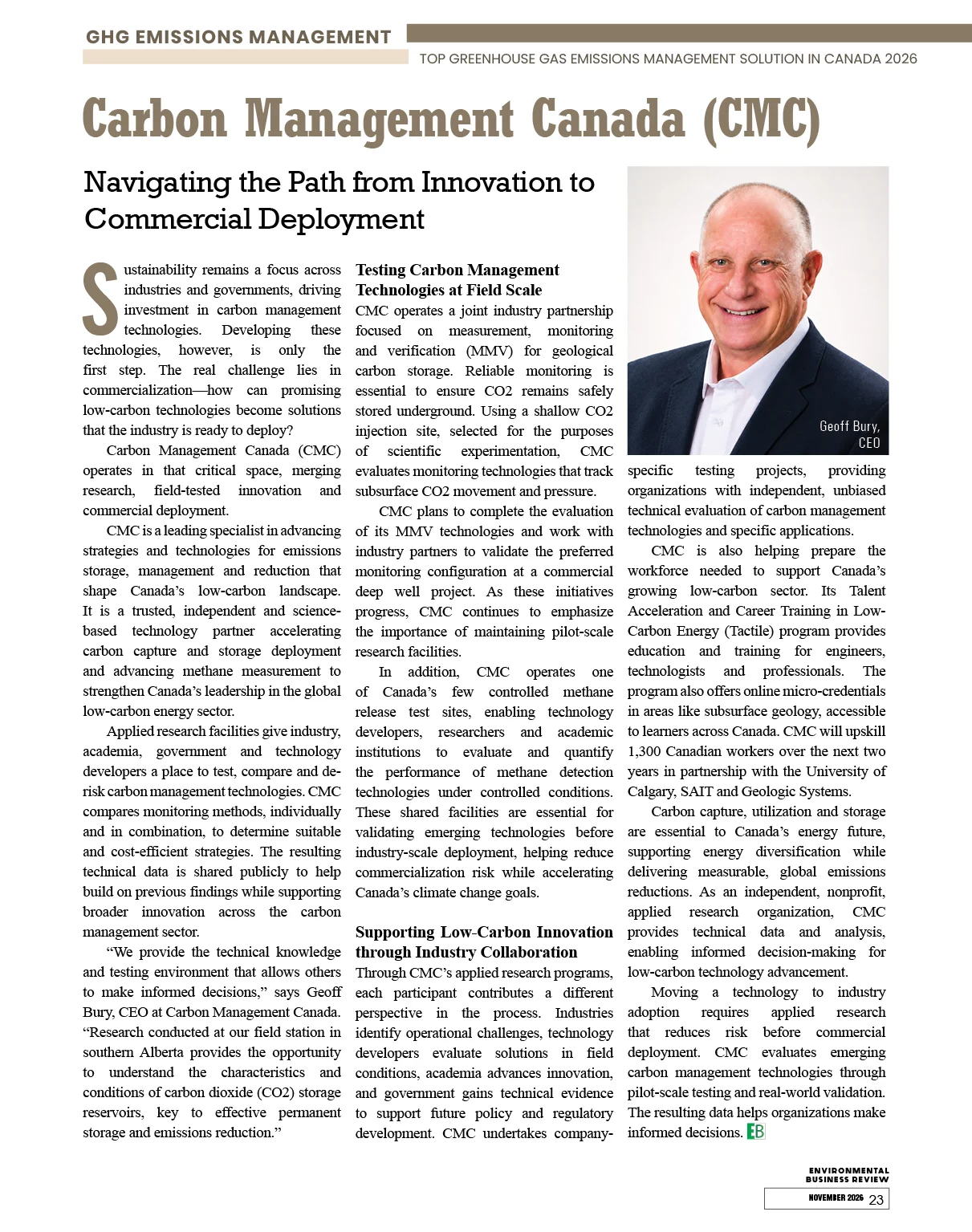
 Geoff Bury, CEO
Sustainability remains a focus across industries and governments, driving investment in carbon management technologies. Developing these technologies, however, is only the first step. The real challenge lies in commercialization—how can promising low-carbon technologies become solutions that the industry is ready to deploy?
Carbon Management Canada (CMC) operates in that critical space, merging research, field-tested innovation and commercial deployment.
CMC is a leading specialist in advancing strategies and technologies for emissions storage, management and reduction that shape Canada’s low-carbon landscape. It is a trusted, independent and science-based technology partner accelerating carbon capture and storage deployment and advancing methane measurement to strengthen Canada’s leadership in the global low-carbon energy sector.
Applied research facilities give industry, academia, government and technology developers a place to test, compare and de-risk carbon management technologies. CMC compares monitoring methods, individually and in combination, to determine suitable and cost-efficient strategies. The resulting technical data is shared publicly to help build on previous findings while supporting broader innovation across the carbon management sector.
“We provide the technical knowledge and testing environment that allows others to make informed decisions,” says Geoff Bury, CEO at Carbon Management Canada. “Research conducted at our field station in southern Alberta provides the opportunity to understand the characteristics and conditions of carbon dioxide (CO2) storage reservoirs, key to effective permanent storage and emissions reduction.”
Testing Carbon Management Technologies at Field Scale
CMC operates a joint industry partnership focused on measurement, monitoring and verification (MMV) for geological carbon storage. Reliable monitoring is essential to ensure CO2 remains safely stored underground. Using a shallow CO2 injection site, selected for the purposes of scientific experimentation, CMC evaluates monitoring technologies that track subsurface CO2 movement and pressure.
CMC plans to complete the evaluation of its MMV technologies and work with industry partners to validate the preferred monitoring configuration at a commercial deep well project. As these initiatives progress, CMC continues to emphasize the importance of maintaining pilot-scale research facilities.
-
We provide the technical knowledge and testing environment that allows others to make informed decisions.
In addition, CMC operates one of Canada’s few controlled methane release test sites, enabling technology developers, researchers and academic institutions to evaluate and quantify the performance of methane detection technologies under controlled conditions. These shared facilities are essential for validating emerging technologies before industry-scale deployment, helping reduce commercialization risk while accelerating Canada’s climate change goals.
Supporting Low-Carbon Innovation through Industry Collaboration
Through CMC’s applied research programs, each participant contributes a different perspective in the process. Industries identify operational challenges, technology developers evaluate solutions in field conditions, academia advances innovation, and government gains technical evidence to support future policy and regulatory development. CMC undertakes company-specific testing projects, providing organizations with independent, unbiased technical evaluation of carbon management technologies and specific applications.
CMC is also helping prepare the workforce needed to support Canada’s growing low-carbon sector. Its Talent Acceleration and Career Training in Low-Carbon Energy (Tactile) program provides education and training for engineers, technologists and professionals. The program also offers online micro-credentials in areas like subsurface geology, accessible to learners across Canada. CMC will upskill 1,300 Canadian workers over the next two years in partnership with the University of Calgary, SAIT and Geologic Systems.
Carbon capture, utilization and storage are essential to Canada’s energy future, supporting energy diversification while delivering measurable, global emissions reductions. As an independent, nonprofit, applied research organization, CMC provides technical data and analysis, enabling informed decision-making for low-carbon technology advancement.
Moving a technology to industry adoption requires applied research that reduces risk before commercial deployment. CMC evaluates emerging carbon management technologies through pilot-scale testing and real-world validation. The resulting data helps organizations make informed decisions.
De-Risking Carbon Emissions Reduction at Scale
Carbon reduction initiatives rarely stall because organizations lack ambition. Delays usually appear when project teams cannot demonstrate that emissions data is accurate enough for investment decisions, regulatory review or long-term monitoring. Technologies continue to mature, yet confidence often depends on whether performance has been validated beyond laboratory conditions and under the conditions where industrial assets actually operate.
This gap has become more significant as carbon capture, storage and methane reduction programs move toward broader deployment. Organizations evaluating greenhouse gas emissions management services must look beyond technology claims and ask how monitoring methods have been tested, whether measurement approaches can withstand independent scrutiny and how evidence generated today will remain useful as regulations continue to evolve. Technical uncertainty frequently becomes a commercial risk long before infrastructure is commissioned. Canada's carbon management strategy also places increasing emphasis on technologies that can support credible emissions reductions at a commercial scale.
Applied field validation deserves particular attention. Laboratory performance offers only limited assurance when equipment, geological conditions and environmental variables interact differently in real operating environments. Testing technologies under controlled field conditions allows organizations to compare approaches, quantify accuracy and identify combinations of monitoring methods that perform more reliably than relying on a single measurement technique. This process reduces uncertainty before large capital commitments are made.
“Carbon Management Canada helps industry move from promising emissions technologies to proven solutions through independent testing in real-world conditions.”
Collaboration also affects the quality of greenhouse gas management programs. Organizations that work only within their technical teams may produce narrower conclusions than those developed through structured engagement with industry participants, academic researchers and policymakers. Shared research environments allow technologies to be evaluated against broader datasets while producing knowledge that supports both commercial deployment and future regulatory development. Buyers should value partners capable of operating across those groups without introducing commercial bias into technical assessment.
Another consideration is whether the provider contributes to practical deployment rather than remaining focused on research alone. Facilities that bridge laboratory development and commercial implementation shorten the path from concept validation to industrial use. Accessible testing environments for carbon storage monitoring and methane detection help technology developers refine products before they reach customer sites, while giving industrial operators greater confidence in adoption decisions.
Carbon Management Canada (CMC) aligns well with those decision priorities. Operating as an independent nonprofit focused on applied research, it works across industry, academia and government to validate greenhouse gas management technologies under real-world conditions rather than limiting assessment to laboratory settings. Its programs include geological carbon storage monitoring, methane emissions validation and field research facilities that help evaluate technologies before commercial deployment.
Its joint industry partnership supports collaborative testing while publicly available research findings contribute to broader technical confidence. Expertise supporting measurement, monitoring and verification for carbon storage projects is provided through field research infrastructure and applied programs that help organizations assess technologies before full-scale implementation. These capabilities make Carbon Management Canada (CMC) a well-supported choice for executives who place measurable technical evidence, independent evaluation and deployment readiness at the center of greenhouse gas emissions management decisions.
...Read more
Greenhouse Gas Emissions Management Solutions in Canada Info
Q1
What Do Greenhouse Gas Emissions Management Solutions Include?
Greenhouse gas emissions management solutions encompass the range of technologies, test methods and technical services that can be used to measure, monitor and reduce emissions. This can include CO2 storage, methane detection, emissions measurement and the assessment of carbon capture technologies. Good programmes will also look at whether the monitoring methods in question actually produce reliable data in the real world. Field testing is a key element in this process as it allows you to identify any technical issues prior to committing to a full scale deployment. The combination of measurement and independent evaluation can be of huge benefit to decision making and environmental planning. The exact scope of the programme will of course be dependent on the source of emissions, the project in question and the level of evidence required to prove performance.
Q2
How Does Carbon Management Canada Support Emissions Management?
Carbon Management Canada (CMC) is an independent non-profit that advances greenhouse gas emissions management solutions through applied research and field-based technology testing. It operates research facilities which are used by industry, academia, government and technology developers to test and evaluate carbon management technologies. This work includes monitoring of geological carbon storage and the evaluation of methane detection technologies. CMC also produces technical data which is used to allow organisations to compare the various technologies available and to understand their performance. By providing a bridge between the research and the field, CMC helps to close the gap between the development of a technology in the lab and its actual commercial use. This in turn enables better informed decisions to be made on technology selection, implementation risk and emissions reduction strategy.
Q3
How Can Emissions Monitoring Improve Carbon Storage Projects?
Reliable monitoring is key to establishing whether the CO2 that's been injected remains securely underground and whether the storage project is performing as it should. GEMS can combine subsurface measurements with pressure monitoring and other monitoring techniques to track the movement of CO2. These methods can be tested in the field under controlled conditions to establish their capabilities and limitations. The results of such testing can then be used by the project team to select an appropriate monitoring configuration and to increase their confidence in the long term storage plan. An independent technical assessment can also provide the basis for project evaluation and for discussions with regulators. The right approach will of course be dependent on the geology of the site, the measurement requirements and the risks associated with that particular site.
Q4
What Should Organizations Evaluate When Selecting Emissions Management Technologies?
Organisations looking at Greenhouse Gas Emissions Management Solutions should look at measurement accuracy, test conditions, technical robustness and readiness for commercial deployment. Lab results can give you a first indication of performance but field validation is the only way to know how the technology actually performs under real operating conditions. You should also ask whether the test methodology can be independently verified and whether the data produced is capable of enabling meaningful comparison. Cost is obviously important but the cheapest up front solution may not necessarily be the one that gives you the most reliable long term outcome. A good assessment process will take into account the technical evidence, the level of implementation risk, the monitoring requirements and the value of the findings to future operational decisions.
Q5
How Does Methane Detection Technology Help Reduce Emissions Uncertainty?
Methane detection technologies can be used to identify and quantify emissions which would otherwise be very difficult to measure. GHG Emissions Management Solutions can assist in this area through controlled testing, performance assessment and comparison of different detection technologies. Carbon Management Canada has a controlled methane release test site which is used by technology developers, researchers and academic institutions to assess the performance of detection technologies. The test site provides a controlled environment in which to assess the performance of different measurement tools. The resulting data provides evidence to help users understand the technical capabilities of a technology prior to deployment. Improved validation in this way can assist with technology selection and can in turn lead to more robust methane measurement programmes.
Q6
How Does Workforce Training Support Greenhouse Gas Management?
GHG Emissions Management Solutions are reliant on both the right technology and the people who can apply it. Training is key to developing the technical skills required to assess emissions, interpret measurements and support low carbon projects. Carbon Management Canada has responded to this need through its Talent Acceleration and Career Training in Low Carbon Energy (TACTILE) program. This delivers training for engineers, technologists and others in the sector with a range of options including online micro-credentials in areas such as subsurface geology. The program is a means of building capacity across the low carbon sector in Canada and is a direct complement to the applied research that we do, in that it helps to equip the people who will be working on the actual emissions management and carbon storage projects.
