
Thank you for Subscribing to Environmental Business Review Weekly Brief
Environmental Business Review: Specials Magazine
Phibro Animal Health Corporation
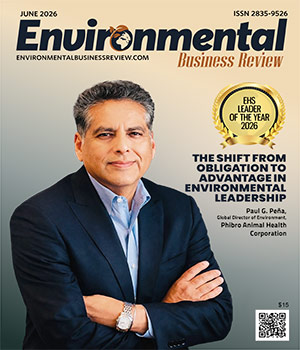
The Shift from Obligation to Advantage in Environmental Leadership
Paul G. Peña brings extensive experience in environmental, health, and safety leadership within global manufacturing environments. With a background in regulatory compliance, operational risk management, and sustainability initiatives, he focuses on building structured systems that improve accountability and performance. His work emphasizes cross-functional collaboration, data-driven decision-making and continuous improvement across international operations. From Compliance Execution to Risk Leadership I have spent much of my career understanding that environmental, health, and safety is not a parallel function to the business. It is the business. At Phibro Animal Health Corporation, that realization has shaped how I think, how I lead, and how I define progress across our global operations. Early in my career, my focus was precise and executiondriven. I worked to understand regulations, close compliance gaps, and ensure that facilities met their obligations. That phase was critical. It taught me discipline and reinforced the importance of consistency in protecting people and operations. But over time, as I moved into broader leadership roles, I began to see the limitations of a compliance-only mindset. Compliance is essential, but it is only the starting point. The real work begins when you move beyond reacting to requirements and start anticipating risk. That shift changed how I approached my role. Instead of asking whether we were compliant, I began asking whether we were prepared. Building Enterprise Visibility through Operational Excellence Baselines One of the most defining efforts in this evolution was establishing an operational excellence baseline across 24 facilities. At the outset, leadership believed environmental performance was being managed effectively. In many ways, it was. Sites were compliant, and teams were doing their jobs. But what we lacked was a unified view. s a unified view. When we began collecting and aligning data, we d
Environmental Investment Service
As sustainability becomes a global priority, the need for clean, healthy air is driving demand across industries and homes. INOVA Air Purifiers sits at the forefront as a leader in air purifier manufacturing. Renowned for cutting-edge air purification, the company consistently upholds high standards of quality, sustainability, and reliability. INOVA makes air purifiers for industry and household consumers, helping them overcome air quality issues, from hospitals and mining sites to everyday householders concerned about pollution, wildfires, or viruses. For over two decades, INOVA has played a vital role in maintaining healthier indoor environments across the globe. By employing an innovative approach to design and sustainable manufacturing, INOVA has developed a high-quality product that is built to last while also meeting the ever-increasing consumer demand for sustainable products. Its approach ensures that every purifier is handcrafted from durable materials and supported by a manufacturing model that benefits the planet and the communities it serves. “Every unit we make is a promise to our planet and customers that clean air and sustainability can go hand in hand,” says Nicholas Kraus, owner and CEO of INOVA. Clean Air Starts at the Source INOVA operates from two purpose-built facilities, one in Denton, Texas, and the other in New South Wales, Australia. These sites serve as manufacturing and distribution hubs, designed to meet the highest quality standards while minimizing environmental impact. Each air purifier is hand-assembled by skilled technicians, ensuring attention to detail and consistent quality. Instead of using plastic casings, INOVA constructs its systems from robust aluminum and steel—materials that are recyclable and built to last. Sustainability is embedded in INOVA’s manufacturing process, starting with the use of locally sourced materials whenever possible. Its U.S. and Australian teams work closely with regional suppliers and manage in-house fabrication, supporting local economies and ensuring strict quality control throughout the process. INOVA purifiers are engineered for performance and efficiency, featuring the largest filters on the market, which means fewer replacements, lower operational costs, and significantly less waste. The company also leads the industry in energy-efficient operation, delivering high-level filtration with minimal power consumption, and integrates renewable energy into its manufacturing wherever possible. At its Australian factory, solar panels power daily operations and regularly generate a surplus, sending up to 30,000 kilowatts back to the grid each summer.

Environmental Training

People make sustainable choices every day. They support local businesses, recycle and seek products with a lower environmental impact. Investing, however, often becomes the exception, shaped by the assumption that sustainable portfolios offer weaker performance or require trade-offs. EGÉA SRI, a fee-only fiduciary investment advisory firm specializing in sustainable, responsible and impact (SRI) investing, works to change that belief. The firm builds customized ESG portfolios that reflect each client’s values while adhering to established investment principles, providing transparent, conflict-free guidance. Its advisors hold the Chartered SRI Counselor (CSRIC) designation from the College for Financial Planning, a credential held by fewer than 1 percent of financial advisors nationwide. This designation equips them with specialized training in sustainable investing, ensuring clients receive expert advice grounded in in-depth ESG knowledge rather than a general-market interpretation.
Indoor Air Quality Services
Future Environment Designs, Inc.
Keeping Compliance Aligned in Regulated Environments
Angelo Garcia, III, CIEC, CEOP, Principal-Industrial Hygienist
For organizations that operate in environments affected by asbestos, mold, and indoor air quality requirements, the core responsibility is ensuring workers are cleared, documented, and ready before work begins. While compliance is often structured around annual requirements, it is frequently managed in pieces. That fragmentation becomes visible before a worker ever steps into a facility, when training, medical clearance, fit testing, certification, licensing, and documentation must align to allow mobilization. In practice, these processes rarely occur in one place, and delays often surface when schedules tighten, and work is ready to begin, but clearance is incomplete. Future Environment Designs exists to keep workers continuously ready for regulated work. With nearly four decades in operation, the company is a full-time training provider for firms operating in hazardous environments. Its wraparound services ensure workers leave cleared, documented, and ready to return directly to the job. Rather than acting as a one-time vendor, it functions as an ongoing partner, bringing instruction, respirator fit testing, medical coordination, documentation management, and regulatory guidance into a single, continuous process. “It’s rarely the work itself that creates risk. The challenge is keeping training, clearance, and documentation aligned so mobilization isn’t delayed. Our role is to keep those requirements together so people can leave training cleared and return straight to the job,” says Angelo Garcia, III, CIEC, CEOP, Principal-Industrial Hygienist. Future Environment Designs works with a broad mix of institutional, industrial, and contracting organizations that are accountable for maintaining compliance in active facilities. Its clients include large institutional operators like PSE&G, National Grid, and Brookhaven National Laboratory, as well as environmental consultants, abatement contractors, restoration firms, and demolition companies. For these organizations, the company focuses on preparing workers, supervisors, consultants, and assessors to operate safely and legally during maintenance, renovation, and demolition activities involving regulated materials. Training focuses on identifying and controlling asbestos and indoor air quality risks in real operating conditions.

Environmental Monitoring

The Ultimate Goal of Safety Leadership Is Influence
Britt Howard, Group Director, Assurance Americas, Worley [ASX: WOR]
Environmental Monitoring

Fostering Eco-friendly Practices through Technology
Douglas Glorie, Vice President - Environmental Services, STV [NYSEARCA: SLV]
Plastic Recycling

The importance of Climate Tech and AI in Driving Sustainability Transformation
Jeff Caton, Vice President, Director of Climate and Sustainability Services, Environmental Science Associates
Environmental Compliance

Shifting Sustainability Priorities in North American Energy
Fiona Baker, Strategic Sustainability Science Research Program Manager and Greg Rouse, Senior Technical Leader – Sustainability at EPRI
Sustainable Packaging

Transforming Freight Transportation through Sustainable Innovation
John Lovenburg, Vice President, Environment and Sustainability, BNSF Railway

IN MY OPINION
Engineering and Consulting
Maintaining Pipeline Integrity
Charles E Venditti, Director | Pipeline Integrity | Business Development | Project Management | Engineering | Compliance, TRC Companies

LAST WORD
Sustainable Packaging
Embracing Resilience to Boost Food and Nutrition Security
Cristiane Lourenco, Global Director, Regenerative Agriculture and Smallholders Farmers, Vegetables, Bayer
IN FOCUS
Advantages of Sustainable Steel Can Packaging
Sustainable steel packaging improves product protection, minimizes environmental impact, supports circular economy goals, and offers a durable, recyclable solution.
Strategic Groundwater Management: Building Resilience and Compliance
Hydrogeologic management provides the optimal approach for informed planning and long-term operational viability.
EDITORIAL
Building Resilient Operations in a High-Risk Environment
Environmental leadership is entering a new phase driven by operational resilience, infrastructure readiness and measurable accountability. As climate volatility, regulatory pressure and resource constraints intensify, organizations are increasingly aligning sustainability priorities with long-term business continuity. This edition of Environmental Business Review explores how companies are responding through disciplined execution and systems-level thinking.
Leading this conversation is Phibro Animal Health, where Paul G. Peña was recognized as the EHS Leader of the Year 2026 for advancing a more integrated approach to environmental, health and safety strategy. Through enterprise-wide standardization across 24 facilities, the company strengthened environmental visibility, improved risk governance and created a more connected framework for decision-making. Its approach reflects a broader reality facing global operators today, where environmental stewardship is no longer separate from business performance.
The issue also explores how resilience is becoming central to sectors facing mounting environmental pressure. Cristiane Lourenço, Global Director, Regenerative Agriculture and Smallholders Farmers, Vegetables at Bayer, highlights the growing intersection between climate adaptation, water scarcity and food security, arguing that resilience must become a core business consideration rather than a parallel sustainability initiative. Her perspective emphasizes the need for organizations to rethink innovation cycles, investment priorities and long-term agricultural planning as environmental conditions continue to shift.
In the energy sector, Director | Pipeline Integrity | Business Development | Project Management | Engineering | Compliance at TRC Companies, Inc., examines how pipeline operators are preparing for a lower-carbon future while maintaining safety and operational reliability. His insights into hydrogen transportation, carbon dioxide infrastructure and evolving regulatory demands underscore the increasing complexity of managing critical energy systems during transition periods.
What connects the leaders featured in this edition is a clear operational mindset: resilience is becoming a defining measure of business strength. Their work demonstrates that long-term environmental progress will depend on the ability to translate strategy into durable systems, measurable action and accountable leadership.
We invite you to explore the insights and perspectives featured throughout this edition.
