Thank you for Subscribing to Environmental Business Review Weekly Brief


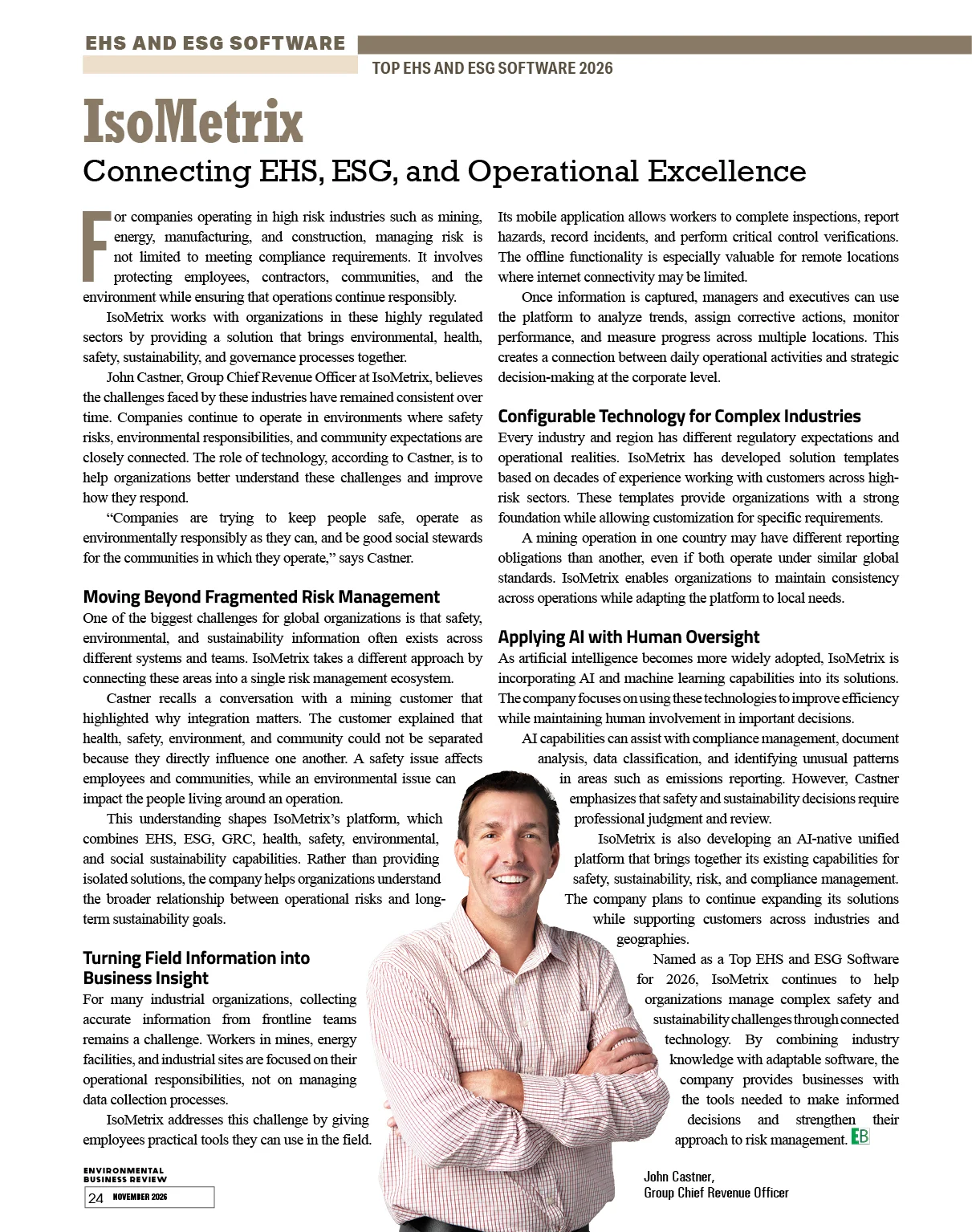
 John Castner, Group Chief Revenue Officer
For companies operating in high risk industries such as mining, energy, manufacturing, and construction, managing risk is not limited to meeting compliance requirements. It involves protecting employees, contractors, communities, and the environment while ensuring that operations continue responsibly.
IsoMetrix works with organizations in these highly regulated sectors by providing a solution that brings environmental, health, safety, sustainability, and governance processes together.
John Castner, Group Chief Revenue Officer at IsoMetrix, believes the challenges faced by these industries have remained consistent over time. Companies continue to operate in environments where safety risks, environmental responsibilities, and community expectations are closely connected. The role of technology, according to Castner, is to help organizations better understand these challenges and improve how they respond.
“Companies are trying to keep people safe, operate as environmentally responsibly as they can, and be good social stewards for the communities in which they operate,” says Castner.
Moving Beyond Fragmented Risk Management
One of the biggest challenges for global organizations is that safety, environmental, and sustainability information often exists across different systems and teams. IsoMetrix takes a different approach by connecting these areas into a single risk management ecosystem.
Castner recalls a conversation with a mining customer that highlighted why integration matters. The customer explained that health, safety, environment, and community could not be separated because they directly influence one another. A safety issue affects employees and communities, while an environmental issue can impact the people living around an operation.
This understanding shapes IsoMetrix’s platform, which combines EHS, ESG, GRC, health, safety, environmental, and social sustainability capabilities. Rather than providing isolated solutions, the company helps organizations understand the broader relationship between operational risks and long-term sustainability goals.
Turning Field Information into Business Insight
For many industrial organizations, collecting accurate information from frontline teams remains a challenge. Workers in mines, energy facilities, and industrial sites are focused on their operational responsibilities, not on managing data collection processes.
-
Companies are trying to keep people safe, operate as environmentally responsibly as they can, and be good social stewards for the communities in which they operate.
IsoMetrix addresses this challenge by giving employees practical tools they can use in the field. Its mobile application allows workers to complete inspections, report hazards, record incidents, and perform critical control verifications. The offline functionality is especially valuable for remote locations where internet connectivity may be limited.
Once information is captured, managers and executives can use the platform to analyze trends, assign corrective actions, monitor performance, and measure progress across multiple locations. This creates a connection between daily operational activities and strategic decision-making at the corporate level.
Configurable Technology for Complex Industries
Every industry and region has different regulatory expectations and operational realities. IsoMetrix has developed solution templates based on decades of experience working with customers across high-risk sectors. These templates provide organizations with a strong foundation while allowing customization for specific requirements.
A mining operation in one country may have different reporting obligations than another, even if both operate under similar global standards. IsoMetrix enables organizations to maintain consistency across operations while adapting the platform to local needs.
Applying AI with Human Oversight
As artificial intelligence becomes more widely adopted, IsoMetrix is incorporating AI and machine learning capabilities into its solutions. The company focuses on using these technologies to improve efficiency while maintaining human involvement in important decisions.
AI capabilities can assist with compliance management, document analysis, data classification, and identifying unusual patterns in areas such as emissions reporting. However, Castner emphasizes that safety and sustainability decisions require professional judgment and review.
IsoMetrix is also developing an AI-native unified platform that brings together its existing capabilities for safety, sustainability, risk, and compliance management. The company plans to continue expanding its solutions while supporting customers across industries and geographies.
Named as a Top EHS and ESG Software for 2026, IsoMetrix continues to help organizations manage complex safety and sustainability challenges through connected technology. By combining industry knowledge with adaptable software, the company provides businesses with the tools needed to make informed decisions and strengthen their approach to risk management.
Connecting Field Risk with Enterprise EHS and ESG Oversight
EHS and ESG software is often purchased at headquarters but succeeds or fails much closer to the work itself. Safety events, environmental observations and compliance obligations originate across sites where connectivity may be inconsistent and data capture competes with production work. At the same time, executives need comparable information across locations without stripping away the regulatory differences that matter locally. A useful system has to bridge those two realities rather than optimize for one.
Field usability deserves close scrutiny because reporting quality depends on how easily employees can record information during the workday. Mobile access matters, but access alone is insufficient where mines, energy sites or industrial facilities operate beyond reliable networks. Buyers should examine whether inspections, hazard reporting and control checks can continue offline, then synchronize without creating duplicate records or gaps. Language support can be equally important across multinational workforces. Poor field adoption eventually becomes a management problem because dashboards can only reflect what enters the system.
“Safety events, environmental observations and compliance obligations originate across sites where connectivity may be inconsistent and data capture competes with production work.”
The harder procurement decision often sits behind that interface. EHS and ESG data rarely belongs to a single function. Safety events can trigger corrective actions while environmental obligations may carry separate approval paths, deadlines or site-specific reporting requirements. Systems divided into isolated modules can make cross-functional oversight harder when the underlying risks intersect. Executives should look for a common management structure that can route records into follow-up actions and support reporting across business units without forcing every site into identical workflows.
Traceability also matters once information moves upward. Executives should be able to see how a reported event was reviewed, what action followed and whether closure occurred without reconstructing the sequence across separate tools. That record becomes especially important when internal assurance or external scrutiny reaches beyond the headline KPI.
Configuration needs similar discipline. Global companies usually want a shared baseline for enterprise reporting, yet regulatory requirements vary by jurisdiction and facility. Software that is too rigid can push local teams toward spreadsheets and workarounds. Excessive customization creates the opposite problem, making upgrades harder and processes inconsistent. The stronger model starts with established workflows, then permits controlled changes for local fields, reporting obligations and regulatory requirements. Governance over configuration matters almost as much as configurability itself.
“IsoMetrix also supports offline mobile use, allowing field personnel to complete inspections, verify critical controls and report incidents where connectivity is unreliable.”
AI adds another layer to the assessment. Its practical use in EHS and ESG is less about replacing professional judgment than reducing manual review. Permit documents can be parsed into compliance requirements, incident entries can receive classification assistance and emissions data can be checked for unusual values. Such functions are useful only when review and approval remain visible. Buyers handling safety information, personal data or compliance records should examine where human validation occurs and how suggested actions enter existing workflows.
IsoMetrix provides an integrated safety, sustainability, risk and compliance management system designed to connect field activity with management oversight. IsoMetrix also supports offline mobile use, allowing field personnel to complete inspections, verify critical controls and report incidents where connectivity is unreliable. Its solution templates establish a common baseline while configuration accommodates site-specific regulatory requirements. AI-assisted functions include a Compliance Plan Builder for interpreting permit and agreement requirements, guided classification and anomaly detection, while human review remains part of the process. For enterprises balancing consistent reporting with local variation, IsoMetrix merits consideration where integrated EHS and ESG management is a central requirement.
...Read more
EHS and ESG Software Info
Q1
What Is EHS and ESG Software?
EHS and ESG Software helps businesses manage workplace safety, environmental responsibilities and sustainability goals in one place. EHS deals with environmental, health and safety practices, while ESG looks at a company's wider environmental, social and governance performance. These platforms make it easier to report incidents, assess risks, meet regulatory requirements, track emissions and prepare sustainability reports. With information organized in one system, businesses can keep accurate records and see how their daily operations affect their larger sustainability goals. This is especially useful for companies operating across multiple locations or dealing with complex safety and environmental regulations.
Q2
How Does IsoMetrix Connect EHS Management With Sustainability Reporting?
IsoMetrix provides EHS and ESG Software through an integrated platform combining environmental management, occupational health and safety, enterprise risk, compliance and sustainability modules. Designed for high-risk industries, including mining, energy and manufacturing, its configurable system connects operational information with broader reporting requirements. Organizations can manage incidents, inspections, permits and corrective actions while maintaining related sustainability data. IsoMetrix also offers Lumina, an ESG management solution that centralizes information on carbon emissions, energy, water, waste and governance, helping organizations connect everyday operations with sustainability reporting.
Q3
Why Is Integrated EHS and ESG Data Important for Businesses?
Organizations often collect safety, environmental and sustainability information through different departments and reporting systems. EHS and ESG Software can connect these records, reducing duplicated work and improving consistency. For example, environmental monitoring data may support both regulatory compliance and sustainability disclosures. Shared information also helps managers understand relationships between operational risks and environmental performance. Instead of preparing reports from disconnected spreadsheets, teams can work with a common set of records. This improves transparency and gives decision-makers a clearer understanding of organizational performance.
Q4
What Should Organizations Look for in an EHS and ESG Platform?
Businesses evaluating EHS and ESG Software should consider regulatory coverage, reporting capabilities, workflow flexibility and integration with existing systems. A suitable platform should accommodate different operational requirements across facilities while maintaining consistent data standards. Incident management, inspections, audit trails and corrective action tracking are important for EHS operations. Sustainability teams may also need emissions calculations, performance dashboards and support for recognized reporting frameworks. Organizations should assess whether the software can adapt to changing requirements without creating unnecessary administrative work.
Q5
How Does IsoMetrix Help Organizations Manage Environmental and Safety Risks?
IsoMetrix extends EHS and ESG Software through specialized applications for safety management, environmental monitoring, compliance and enterprise risk. Its environmental management capabilities align with ISO 14001 principles and support inspections, audits, permits, spills and environmental impact assessments. A centralized action manager helps teams track responsibilities across facilities. Through IsoMetrix Lumina, organizations can calculate Scope 1, 2 and 3 emissions and prepare disclosures using frameworks such as GRI, ISSB and ESRS. Configurable dashboards also help managers compare performance across sites and monitor progress toward sustainability targets.
Q6
How Can EHS and ESG Technology Improve Organizational Accountability?
EHS and ESG Software can strengthen accountability by making responsibilities, performance indicators and corrective actions more visible. Digital workflows help employees document inspections, report incidents and monitor outstanding compliance tasks. Centralized sustainability information also allows organizations to review environmental targets and identify areas requiring attention. When managers can access consistent records across departments, they are better equipped to evaluate risks and communicate progress. Over time, this visibility can support more informed decisions, stronger internal coordination and greater confidence in regulatory and sustainability reporting.
