
Thank you for Subscribing to Environmental Business Review Weekly Brief
Environmental Business Review: Specials Magazine
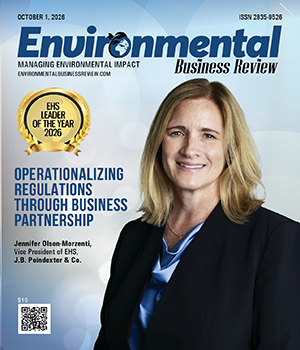
Jennifer Olson-Morzenti serves as vice president of environmental, health and safety (EHS) at J.B. Poindexter & Co. Guided by the belief that EHS is most effective when regulations become part of everyday manufacturing rather than existing as a separate compliance function, she works to integrate safety, environmental stewardship and compliance into daily operations across the company’s approximately 70 manufacturing locations in the U.S. and Canada. Her leadership in embedding EHS into business operations while strengthening collaboration across a decentralized manufacturing organization has earned Jennifer Olson-Morzenti recognition as EHS Leader of the Year 2026 by Environmental Business Review. Turning Operational Experience into Better EHS Leadership My career began in the U.S. Air Force in military public health, where I worked in communicable disease control. Prevention became the foundation of my thinking because I saw how well-designed systems could protect people before problems occurred. After leaving the Air Force, I moved into pharmaceutical manufacturing, taking on responsibilities across safety, quality, facilities, laboratory support, manufacturing and operations. Every role expanded my perspective, but it also confirmed that EHS was where my passion belonged. Manufacturing and operations became the final piece of the puzzle. For the first time, I experienced the competing priorities operations leaders manage every day, from productivity and quality to customer commitments and financial performance. That perspective changed how I approached EHS. Regulations made far more sense when they fit the realities of manufacturing rather than expecting manufacturing to adapt to them. Today, I still draw on those lessons. Rather than asking operations to work around compliance requirements, I focus on operationalizing them by building EHS directly into production workflows. Compliance is far more effective when it becomes part of the way work is perfo
Top Mold Remediation Solutions 2026
Mold rarely stays where it first appears. By the time growth becomes visible on a wall, windowsill or other surface, microscopic spores may already have traveled through the building via HVAC systems and natural airflow. What looks like a localized problem can extend well beyond the visible growth, with spores reaching other areas where moisture can support further growth. Pure Maintenance treats remediation from that whole-building perspective. Its VaPURE™ process takes a whole-building approach by evaluating conditions beyond the area of visible mold and applying products only to eligible sites and surfaces in accordance with their EPA-approved labeling. The first step is a mold treatment that reduces the number of mold spores. The second step may include application of an EPA-registered antimicrobial product to eligible surfaces. When applied according to its EPA-approved label, the treatment forms an invisible microbiostatic coating that helps inhibit the growth of mold and mildew on treated surfaces..

Data-Driven Waste Managed Services

For most businesses, waste management rarely reaches the top of the strategic agenda. Yet, day-to-day operations can become an invisible drain on resources, time, and money. A retail store manager might find herself dealing with overflowing containers and upset customers, unsure if a missed pickup was ever scheduled or completed. A facilities director may spend hours reconciling invoices filled with charges that cannot be verified. Sustainability officers, meanwhile, often scramble to compile diversion reports only to find that the necessary data is scattered across multiple vendors. These frustrations may seem mundane, but they are recurring pain points that affect thousands of companies across the U.S. Waste Harmonics Keter recognizes that waste should not be an afterthought or an operational burden. Instead, it should be a streamlined function with clarity, accountability, and measurable outcomes. The company has created a model that delivers scalable, reliable solutions by combining nationwide coverage with a localized, customer-first approach and layering on advanced technology. For clients, the result is predictability, cost efficiency, and sustainability support, backed by a team committed to proactive partnership. “Customer centricity is what we do every day,” explains Stephen Mohan, chief commercial officer of Waste Harmonics Keter. “Clients value consistency, scalability, and reliability, and we’ve built our model around those needs. That is how we deliver real trust.” Offering Unified Reporting Platform The waste industry has long suffered from a lack of visibility and accountability. Mohan notes that one of the most common frustrations businesses face is not knowing whether they have been serviced. This creates uncertainty, especially when containers overflow or clients are left second-guessing if a vendor has fulfilled obligations. Invoicing is another widespread source of pain, with charges often difficult to verify and disputes consuming valuable time. Sustainability, too, becomes a struggle in such an environment. Without reliable data and integrated reporting, companies cannot track diversion goals or demonstrate compliance with internal or regulatory requirements. Instead of waste management supporting their operations, businesses often find themselves dragged into it, managing inefficiencies that take focus away from core priorities.
CXO INSIGHTS

Fostering Eco-friendly Practices through Technology
Douglas Glorie, Vice President - Environmental Services, STV [NYSEARCA: SLV]

25 Years of Environmental Excellence: Celebrating Delaware Norths Greenpath Program
Debbie Friedel, Corporate Director of Sustainability, Delaware North

The importance of Climate Tech and AI in Driving Sustainability Transformation
Jeff Caton, Vice President, Director of Climate and Sustainability Services, Environmental Science Associates

From Incident to Insight in Safety Leadership
Matthew Shearer, Director of Environmental Health & Safety, Cash Construction Company, Inc., a MasTec Company

Building the Future of EHSS Leadership: Safety, Sustainability and Culture
Steve Curry, Sr. EHSS Manager, City Brewing Company


IN FOCUS
Environmental Concerns Reshape Tree Trimming and Removal Services
Tree trimming and removal practices are evolving to prioritize environmental protection, focusing on preserving mature trees and minimizing habitat loss.
Moisture Control: Mold Remediation Solutions Driving Healthier Buildings
Mold remediation solutions improve indoor environments through moisture control, advanced inspections, effective restoration, healthier air quality, innovative technologies and lasting building protection.
EDITORIAL
Making Environmental Responsibility Practical
Environmental responsibility is becoming more closely tied to everyday business operations. Companies are finding practical ways to strengthen EHS programs, improve remediation and embed sustainability into how work gets done. This issue of Environmental Business Review explores those approaches, with a focus on leadership, technology, training and operational discipline.
Our cover story features Jennifer Olson-Morzenti, Vice President of EHS at J.B. Poindexter & Co., recognized as EHS Leader of the Year 2026. Drawing on experience across public health, pharmaceutical manufacturing and operations, Olson-Morzenti approaches EHS from the perspective of how work is actually performed. Her approach combines centralized expertise with an understanding of each business’s EHS maturity, while practical training methods help employees apply requirements without unnecessarily disrupting production. She also sees technology as an enabler for stronger data analysis, ergonomic assessments and training.
Also recognized is Pure Maintenance as the Top Mold Remediation Solutions 2026. Its VaPURE™ process looks beyond visible mold to consider conditions throughout a building, with treatments applied to eligible sites and surfaces according to EPA-approved labeling. The company’s approach can reduce the need for extensive demolition in appropriate situations, while post-treatment testing may be used to evaluate changes in airborne mold-spore levels.
The issue also features Douglas Glorie, Vice President - Environmental Services at STV, who discusses deferred maintenance, environmental education and the growing role of technology in data collection, analysis, mold inspections and air monitoring. Debbie Friedel, Corporate Director of Sustainability at Delaware North, offers insight into GreenPath and its focus on supply chain, waste, energy and emissions, water and the built environment.
The insights in this issue show how practical leadership can strengthen environmental performance without losing sight of business realities. We invite our readers to explore these perspectives and consider how thoughtful EHS and sustainability practices can support stronger operations.
