Thank you for Subscribing to Environmental Business Review Weekly Brief
Environmental Business Review: Specials Magazine
ShurGreen Organic Recycling
Building a Full-Circle Future for Organic Waste Recovery
Waste has traditionally been defined by what happens when a material is no longer needed. In food manufacturing, that can mean organic byproducts left behind once an ingredient has served its purpose, a production run is complete, or a process has reached its final stage. Once outside the production line, these materials are often treated as something to be removed, managed, and ultimately disposed of. But that definition is changing. Organic byproducts can contain significant nutritional and productive value. What appears to be waste at the end of one process can become an input for another—through animal feed, crop production, renewable energy, or other beneficial applications. The challenge is not simply finding somewhere for these materials to go. It is finding a way to move, process, and repurpose them efficiently enough to create value without compromising the demands of food production. For food manufacturers, those demands are considerable. Production lines must remain efficient, facilities must meet stringent safety and sanitation requirements, and sustainability commitments must translate into practical results. Managing organic byproducts therefore sits at the intersection of operational efficiency, environmental responsibility, and resource recovery. This is where ShurGreen Organic Recycling has positioned itself.
Environmental Compliance
Locus Technologies
One Platform for Defensible Environmental Intelligence
Neno Duplan, Founder and CEO
Environmental compliance depends on three questions: what applies, who is responsible and can the organization prove what was done? Those answers become harder when data is scattered across field devices, laboratories, spreadsheets, legacy systems and departmental databases. Locus addresses that fragmentation through a centralized lifecycle, carrying environmental data from collection through workflows, calculations, reporting and audit in one governed environment. It anchors that lifecycle in a cloud-native platform that unifies environmental, sustainability and water-quality data. Measurements, permits, calculations, workflows and reporting stay connected so information can be collected once and used across EHS compliance, ESG, water and operational programs. Teams can standardize processes across facilities while accommodating local requirements, reducing missed obligations and maintaining clear lineage through validation, review, reporting and audit. As AI moves deeper into EHS and ESG workflows, the governed foundation matters more because AI automation is only as reliable as the environmental data feeding it. “The future is a shift from environmental data management as a reporting obligation to environmental intelligence as an operating capability,” says Neno Duplan, founder and CEO, who has kept technology at the center of Locus since founding it in Silicon Valley three decades ago..

Carbon Credit Project Development Services
Guardian Plug & Abandonment
Turning Silent Leaks into Valuable Carbon Credits
Michael Goodman, General Manager
Abandoned oil and gas wells may seem like relics of the past, but they’re quietly leaking one of the most potent greenhouse gases into our atmosphere. Over 80 times more powerful than carbon dioxide in trapping heat, methane, the primary component of natural gas, makes these wells a critical focus in the fight against climate change and a major factor in the carbon credit economy. Guardian Plug & Abandonment is advancing this effort by permanently plugging high-risk wells, quantifying avoided emissions and developing carbon credit projects by documenting and validating these reductions. Numerous gas-leaking wells remain unplugged across the U.S. due to limited enforcement and financial bonding requirements. In many cases, operators abandon their liabilities, leaving the burden of clean-up to local agencies with limited funding and resources to get wells plugged and sites cleaned up. For this reason, there are hundreds of thousands of unplugged and idle wells across the nation. Guardian Plug & Abandonment primarily works with two recognized registries—CarbonPath and BCarbon. Its methodologies quantify emissions reductions from voluntarily plugging wells. The volume of gas that would otherwise escape is converted to carbon-dioxide-equivalent (CO2e) emissions reductions after the wells are plugged with multiple cement and mechanical plugs within the wellbore. “We’re able to get these wells plugged decades ahead of schedule and stop emissions early, leading to positive climate action,” says Michael Goodman, General Manager. Each initiative starts with close coordination that involves small operators seeking to plug aging liabilities and landowners reclaiming unproductive land. Surface infrastructure is also cleared, and the land is graded to the landowner’s specifications, leaving the land available for future use. Once the well is sealed and the impact of the emissions is verified, the company sells the resulting carbon credits, offering buyers a transparent and measurable way to support methane reduction. To date, the company has plugged nine wells and generated hundreds of thousands of CO2e credits. For clients with active wells, the CarbonPath methodology is utilized, which calculates emissions that would have occurred if the remaining hydrocarbons in the wellbore were extracted and combusted. Guardian Plug & Abandonment works with operators to assess reserves, quantify offsets, plug wells and restore the land. Guardian Plug & Abandonment’s first project with CarbonPath generated several thousand credits after working with a small oil and gas operator to halt production early.
Professional Pest Management

Recycling in the Environmental Industry
Stephanie Wernette, JD, QISP, ENV SP, Western Region Manager - Multi-Media Compliance, TRC Companies, Inc.
Engineering and Consulting

Sustainable Solutions: Partnering with Plastic Beach to Recycle Plastic Film
Joe Hess, MPH, CSP, Sr Director, Facilities and EH&S, Gilead Sciences, Inc [NASDAQ: GILD]
Environmental Compliance

Reinvigorate Food Safety: A Proactive Approach to QHSE & EHS Compliance
Dr. Zena E. Glover, Director of Quality Assurance and Operations, Compass Group USA
Ecological Restoration

Building Sustainability Into Everyday Operating Culture
Jason Jacobson, Environmental Manager, Pacific Foods
Pollution Control

Designing Environmenta L Strategy As A Business Imperative
Jeremy Martin, Environmental Health & Safety Manager, SignResource

IN MY OPINION
Sustainable Packaging
Compensated Fuels: Enabling Energy Transition W/O Breaking The Bank. The Role Of Compensated Fuels In A Balanced Energy Transition
Jonathan (J.W.) Hackett, Senior Director, Advocacy and Public Policy, Global Partners LP

LAST WORD
Environmental Compliance
Fine-Tuning Organizational Levers for Safety Excellence
Steve Davis, VP of EHS, Forbes Bros. Group of Companies
IN FOCUS
Environmental Vegetation Management: Balancing Ecosystem Health and Infrastructure Protection
Environmental vegetation management supports biodiversity, protects infrastructure, reduces wildfire risks, and promotes sustainable land and resource management.
Responsible AI: Advancing Trustworthy Environmental Business Practices
Responsible AI improves resource efficiency, enables transparent decision-making and supports environmental monitoring.
EDITORIAL
Turning Waste into Value through Environmental Innovation
Environmental management is evolving from disposal and compliance toward resource recovery, data-driven oversight and measurable sustainability. This issue of Environmental Business Review explores that shift through organic waste recycling and EHS compliance, supported by expert perspectives on food safety, recycling and responsible environmental management.
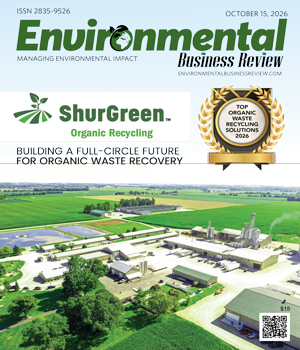
Our cover story recognizes ShurGreen Organic Recycling as the Top Organic Waste Recycling Solutions 2026. Its full-circle model transforms pre consumer organic byproducts into productive resources by connecting food manufacturers with agriculture and other beneficial applications. ShurGreen handles diverse materials including bakery, dairy, meat products, fats, oils, carbohydrates and DAF sludges. Its dedicated fleet, specialized trailers, processing capabilities and 24/7 service provide controlled logistics while supporting sanitation and operational continuity. By integrating recycling, transportation, processing and agricultural expertise, ShurGreen helps manufacturers move from waste disposal toward resource recovery.
The issue also features Locus Technologies as the Top EHS Compliance Software 2026. Its cloud-based platform brings environmental, sustainability and water-quality data together with workflows, calculations, reporting and audit processes. IoT, mobile tools, low-code capabilities, analytics and AI supported functions help environmental teams improve data quality, identify anomalies and manage compliance activities while maintaining traceability and professional oversight.
Contributor Dr. Zena E. Glover, Director of Quality Assurance and Operations at Compass Group USA, emphasizes proactive food safety through employee education, interactive training, real-time monitoring and technology. Her perspective shows how sensors and engagement can reduce human error, improve audit performance and strengthen workplace accountability.
Stephanie Wernette, JD, QISP, ENV SP, Western Region Manager - Multi-Media Compliance, TRC Companies, demonstrates how recycling can be integrated into complex environmental projects. Her railroad right-of way project recovered metal, wood and ballast while treating impacted soil for beneficial use, keeping substantial material from traditional waste streams and generating significant project savings.
Together, these perspectives demonstrate how environmental progress emerges when resource recovery, technology, compliance and practical expertise work together to create measurable value.
